

Engineered vs. Solid Hardwood Flooring for Western New York Basements and Slabs
 Engineered vs. Solid Hardwood Flooring for Western New York Basements and Slabs
Finished basements, split-level lower rooms, and slab-on-grade additions are staples of homes from Tonawanda to Jamestown. Turning a cool, subterranean concrete slab into a warm family lounge, home theater, or guest suite adds meaningful livable square footage—especially during long Western New York winters when indoor gathering spaces work overtime. However, homeowners who love the timeless beauty of real wood often hit a major roadblock below grade: choosing between solid hardwood and engineered hardwood. Understanding how each construction responds to moisture, temperature swings, and concrete subfloors is essential before investing in your space.
Why Concrete Slabs Challenge Traditional Solid Hardwood
Solid hardwood planks are milled from a single, continuous piece of timber, typically three-quarters of an inch thick. While solid wood is celebrated for its longevity and ability to be sanded and refinished multiple times over the decades, it is hygroscopic—meaning it constantly absorbs and releases moisture from its surrounding environment.
In Western New York, concrete foundations sit directly against damp soil, lake-effect snowmelt, and seasonal groundwater fluctuations. Even a basement that feels dry to the touch emits moisture vapor through the porous concrete slab. When solid hardwood is installed below grade or directly over concrete, moisture trapped beneath the boards causes the bottom of the plank to swell faster than the top. This imbalance leads to cupping, buckling, and structural failure. Furthermore, solid hardwood generally requires a wood subfloor for nailing or stapling, which adds height and reduces already precious basement ceiling clearance.
How Engineered Hardwood Solves Below-Grade Challenges
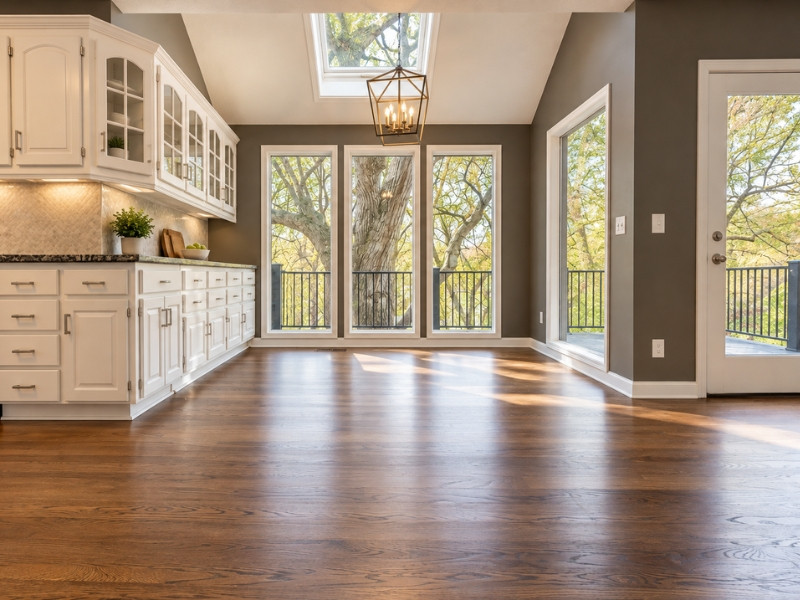
Engineered hardwood delivers the authentic grain, warmth, and character of real wood without the dimensional instability of a single solid plank. Each engineered board features a genuine hardwood top veneer—such as white oak, hickory, or maple—bonded over multiple cross-grained layers of high-density plywood or fiberboard.
Because the grain of each underlying layer runs perpendicular to the layer above it, the core counteracts wood’s natural tendency to expand and contract when relative humidity shifts. This cross-ply construction makes engineered hardwood suitable for below-grade basements and concrete slabs in Orchard Park, Williamsville, and Niagara Falls. Many engineered products can be floated over an approved moisture-barrier underlayment or glued directly to a properly prepared concrete subfloor using moisture-inhibiting adhesives, preserving ceiling height while delivering genuine wood underfoot.
Practical Steps Before Installing Hardwood Below Grade
Even with dimensional stability on your side, proper preparation separates a lasting installation from a costly headache:
- Test concrete moisture levels first: Before selecting planks, have an installation specialist perform a calcium chloride or relative humidity probe test on your slab to verify that vapor emissions fall within manufacturer limits.
- Select a thick wear layer: Choose engineered planks with a wear layer of at least 2mm to 3mm. Thicker veneers resist denting from basement furniture and allow for professional screening or light refinishing years down the road.
- Pair with a vapor-retarding underlayment: If you opt for a floating engineered floor, use an underlayment engineered specifically for concrete slabs to block residual ground vapor and add acoustic dampening.
- Maintain steady indoor humidity: Run a dehumidifier during humid Lake Erie summers and keep indoor relative humidity between 35% and 55% year-round.
Bringing the Showroom to Your Basement Lighting
Basement lighting differs dramatically from sunlit first-floor living rooms—recessed cans and small egress windows can make dark wood stains look nearly black or turn warm tones overly yellow. Working with a team that understands local construction helps eliminate guesswork. As Western New York’s #1 floorcovering dealer since 1965, Custom Carpet Centers backs every project with the Callahan Promise, ensuring expert guidance and reliable installation warranties. Whether you are renovating a lower-level rec room in Williamsville or using our convenient Shop at Home service in Olean to evaluate wood samples under your own basement lighting, our specialists help you match the right engineered construction to your subfloor. Ready to start your project? Explore our Western New York flooring locations or schedule a consultation today to find hardwood built for every level of your home.